You can resolve a ticket perfectly and still lose the customer.
You can answer within seconds and still leave them frustrated.
That’s because customer retention isn’t just about what you say — it’s about how it feels when you say it.
Tone, pacing, hesitation, and emotional shifts all carry meaning. Until recently, those signals were invisible at scale. Today, sentiment analysis changes that by allowing businesses to review customer sentiment and use it to educate the next encounter — turning emotional insight into a competitive advantage.
For modern support teams, this isn’t a “nice-to-have.” It’s the difference between reacting to churn and preventing it.
Why Traditional Customer Metrics Fall Short
Most organizations rely on familiar indicators:
- Average handle time
- First-call resolution
- CSAT surveys
- Ticket volume
These metrics tell you what happened, but not how the customer experienced it.
A customer may say “thanks” while feeling unheard.
They may accept a solution while mentally deciding not to renew.
They may never submit a negative survey — they’ll just quietly leave.
Sentiment analysis fills this gap by continuously analyzing emotional signals across voice, chat, and messaging channels handled through platforms like Maxlink’s unified communications and contact center solutions.
What Is Sentiment Analysis in Customer Communications?
Sentiment analysis uses AI and natural language processing to evaluate:
- Emotional tone
- Stress or frustration levels
- Confidence vs hesitation
- Positive, neutral, or negative intent
- Emotional changes throughout an interaction
Instead of relying on isolated surveys, sentiment analysis listens to every interaction, helping teams understand not just what customers say, but what they mean.
When layered into a modern communication stack — from voice to chat to SMS — this insight becomes actionable in real time and historically.
From Guesswork to Intelligence: Reviewing Sentiment to Educate the Next Encounter
One of the most powerful applications of sentiment analysis is continuity.
Rather than treating every interaction as isolated, businesses can review prior sentiment and educate the next encounter, allowing agents — or AI assistants — to adapt instantly.
Imagine:
- An agent sees that a customer sounded frustrated in their last call
- A follow-up interaction starts with added empathy and clarity
- A retention-focused response replaces a scripted one
This level of awareness is especially impactful in environments powered by CTI and supervisor tools, where sentiment insights can be surfaced directly to agents and managers.
How Analyzing Tone Helps Save At-Risk Accounts
Tone is often the earliest warning sign of churn.
Customers rarely say, “I’m about to leave.”
They say things like:
- “I guess that’s fine.”
- “Never mind, I’ll figure it out.”
- “It’s not a big deal.”
Sentiment analysis detects these signals and flags accounts showing emotional decline — even when issues appear “resolved” on paper.
This enables:
- Proactive outreach before cancellation
- Targeted retention offers
- Escalation to senior support when emotional risk is detected
- Adjusted messaging for future interactions
In high-volume environments like inbound support lines or contact centers with IVR routing, this capability can dramatically reduce silent churn.
Sentiment Analysis Across Voice, Chat, and Messaging
Modern customers move fluidly between channels. A complete sentiment picture must do the same.
Voice Conversations
Voice carries rich emotional data — pace, pitch, pauses, and emphasis. Sentiment analysis layered into cloud calling environments like Cloud PBX voice systems helps identify frustration long before a customer raises their voice.
Chat and Messaging
Text interactions across chat and SMS communication still contain emotional signals: word choice, response speed, and phrasing patterns. Sentiment analysis interprets these nuances at scale.
Unified Customer View
When these channels are unified, sentiment trends emerge — revealing whether a customer’s experience is improving or deteriorating over time.
Real-Time Sentiment vs Historical Insight
The most effective systems don’t choose one — they use both.
Real-time sentiment analysis allows:
- Live prompts for agents
- Escalation during emotionally charged calls
- Adaptive AI responses
Historical sentiment analysis enables:
- Trend analysis across accounts
- Coaching opportunities for agents
- Identification of systemic issues
Together, they create a feedback loop that continuously improves customer experience.
Sentiment Analysis and AI-Powered Support Teams
As AI plays a larger role in customer engagement, sentiment analysis becomes even more critical.
AI voice bots and virtual assistants rely on emotional signals to:
- Adjust tone dynamically
- Decide when to escalate to humans
- Prevent robotic or dismissive responses
This is especially important for businesses operating globally or after hours, where AI handles first contact before routing to live teams via collaboration and receptionist solutions.
Coaching Agents with Sentiment Intelligence
Sentiment analysis doesn’t just protect customers — it develops teams.
Supervisors can use emotional insights to:
- Identify agents who de-escalate well
- Pinpoint interactions that need coaching
- Understand which scripts create frustration
- Improve training with real emotional data
When integrated with supervisor dashboards and monitoring tools, sentiment becomes a coaching asset rather than a performance weapon.
Sentiment Analysis in Proactive Retention Strategies
Retention shouldn’t start at the cancellation request.
By monitoring sentiment trends, businesses can:
- Trigger proactive check-ins
- Offer personalized follow-ups
- Adjust account management strategies
- Align sales and support messaging
This is particularly valuable for subscription-based services and enterprises managing large volumes of customer relationships through unified platforms like Maxlink’s solutions ecosystem.
Privacy, Accuracy, and Trust
Advanced sentiment analysis focuses on patterns, not surveillance.
Modern systems:
- Analyze tone, not personal content
- Work within compliance frameworks
- Improve accuracy over time with contextual learning
When deployed responsibly, sentiment analysis enhances trust by ensuring customers feel heard — not monitored.
Why Sentiment Analysis Is a Competitive Advantage
Customer experience is now a primary differentiator.
Companies that rely solely on speed and resolution will always trail those that understand emotion. Sentiment analysis transforms raw interaction data into insight, empathy, and action.
It allows businesses to:
- Anticipate churn
- Improve loyalty
- Personalize engagement
- Build emotionally intelligent support operations
This aligns directly with the philosophy behind why businesses choose Maxlink Solutions — smarter communication, not just more communication.
Stop Guessing. Start Retaining.
Retention doesn’t fail because teams don’t care.
It fails because they don’t have visibility.
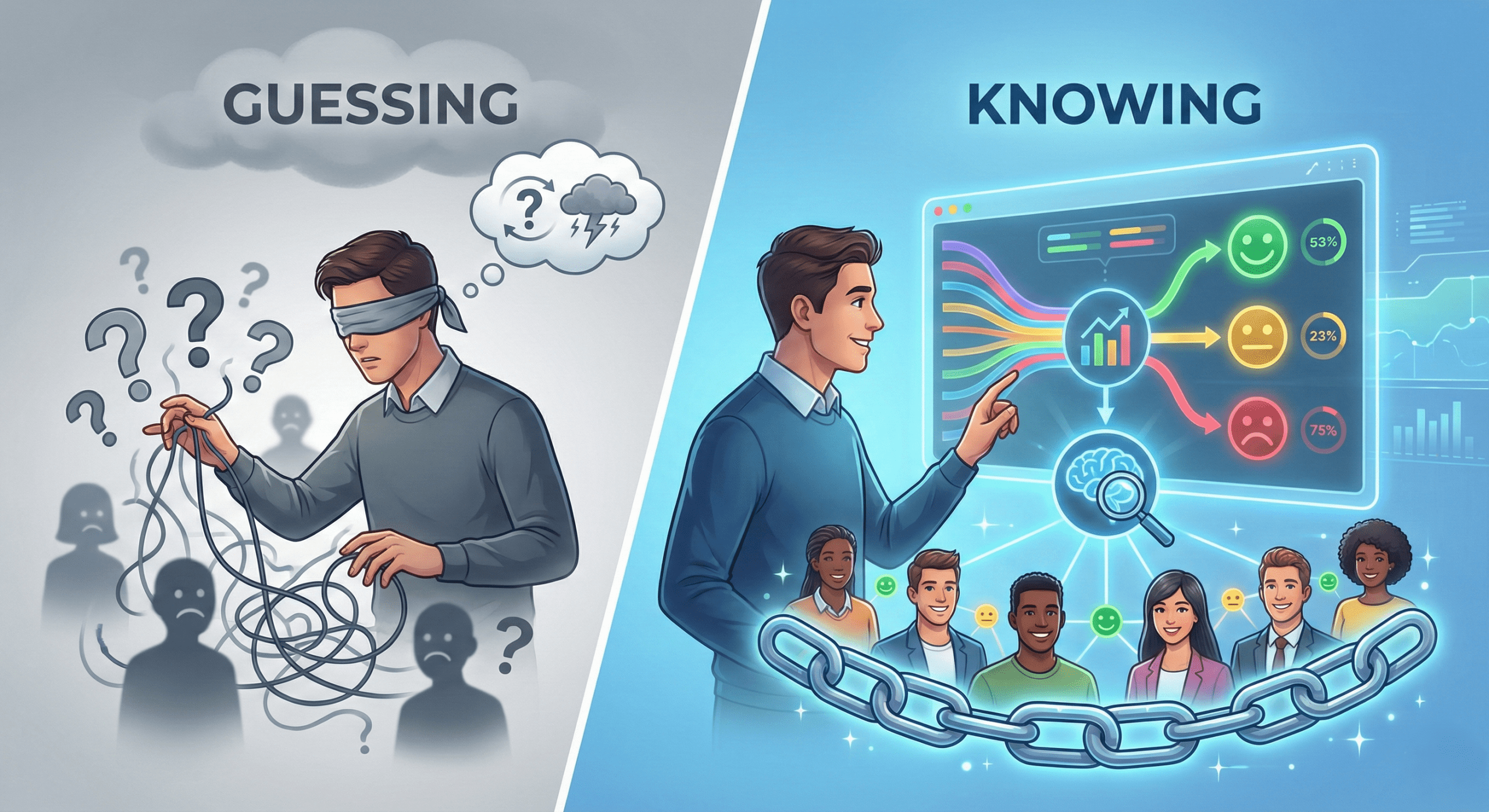
Sentiment analysis removes the blindfold by revealing how customers truly feel — across every call, message, and interaction — and empowering teams to respond intelligently.
When you can review sentiment to educate your next encounter, every conversation becomes an opportunity to strengthen trust instead of risking loss.
If you’re ready to move from reactive support to emotionally intelligent engagement, it’s time to stop guessing — and start knowing.