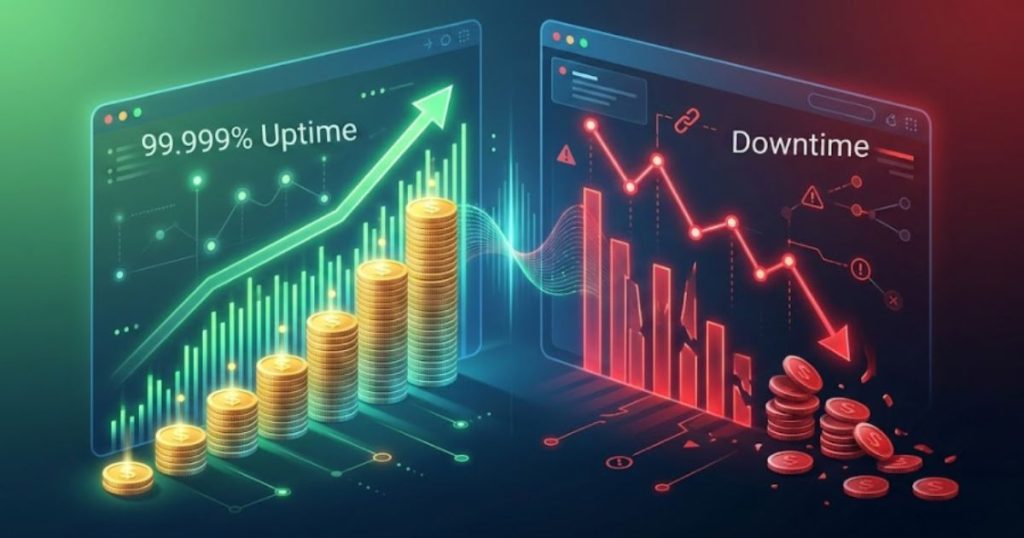
The ROI of Reliability: What 99.999% Uptime Actually Means for Your Revenue
Reliability isn’t a technical buzzword—it’s a revenue strategy. In modern communications, the difference between 99.9% and 99.999% uptime can mean thousands (or millions) in saved revenue, protected brand trust, and uninterrupted customer experiences. That’s why businesses are increasingly prioritizing providers who engineer for reliability from the ground up.
In this article, we’ll unpack what 99.999% SLA uptime really means, quantify the true cost of downtime, and explain how a serverless architecture—like the one used by Maxlink Solutions—delivers measurable ROI through business continuity.
How Downtime Damages Brand Loyalty
In the main article on the ROI of reliability, we focused on how 99.999% uptime protects revenue—but revenue is only part of the story. Reliability also determines how customers feel about your brand. When communication systems fail, trust erodes quickly, and once brand loyalty is damaged, it’s difficult and expensive to rebuild.
In this supporting article, we’ll examine the business impact of downtime on brand loyalty, explain why reliability is a customer experience issue (not just an IT one), and show how reliability-first platforms like Maxlink Solutions help protect long-term brand value.
Downtime Is a Customer Experience Failure
Customers don’t think in terms of servers, carriers, or uptime SLAs. They think in terms of outcomes:
- “I couldn’t reach support.”
- “My call dropped.”
- “No one responded.”
Every outage—no matter how short—creates friction in the customer journey. When those moments happen repeatedly, customers begin to associate your brand with unreliability, even if your product itself is excellent.
First Impressions Are Fragile
For new customers, availability is part of trust-building.
If a prospect calls and encounters:
- Dead lines
- Broken IVR menus
- Long silences or call failures
There is rarely a second chance. Prospects move on to competitors who simply answered the phone.
This is why businesses increasingly rely on Cloud PBX systems designed for continuous availability, rather than fragile, single-point systems.
Downtime Creates Emotional Friction
Brand loyalty isn’t just rational—it’s emotional.
When customers experience downtime:
- They feel ignored
- They lose confidence
- They question reliability in other areas
Even short outages can trigger outsized reactions, especially in industries like finance, healthcare, logistics, and customer support—where communication is mission-critical.
Reliability ensures customers feel heard, supported, and valued, even during peak demand or unexpected events.
Support Failures Hurt the Most
Nothing damages loyalty faster than a failed support interaction.
When systems go down:
- Support agents can’t log in
- Calls queue endlessly
- Supervisors lose visibility
Tools like contact center supervisor dashboards and real-time analytics exist to prevent this—but only if the underlying platform stays online.
High uptime ensures customers reach a human (or at least a functional self-service option) when they need help most.
Inconsistent Availability Breaks Omnichannel Trust
Modern customers expect consistency across channels.
If voice fails but messaging works—or vice versa—trust still takes a hit. True reliability means every channel stays available:
Consistency reassures customers that your brand is dependable in all circumstances.
Repeated Downtime Trains Customers to Leave
Customers are surprisingly forgiving—once.
But repeated outages create a pattern:
- First failure → frustration
- Second failure → doubt
- Third failure → churn
At that point, price discounts and apologies rarely restore trust. The cost of acquiring a replacement customer is often far higher than the cost of preventing downtime in the first place.
Reliability, therefore, is a retention strategy.
How Reliability Protects Brand Reputation at Scale
High-availability platforms prevent brand damage by design:
- Redundant call routing prevents silence
- Serverless infrastructure absorbs traffic spikes
- Distributed SIP trunking avoids carrier-level failures
This is how businesses maintain confidence during product launches, seasonal spikes, or unexpected events.
Campaigns powered by voice broadcasting and customer-facing services remain reliable—even under load.
Internal Confidence Becomes External Confidence
Reliability also shapes how employees represent your brand.
When teams trust their tools:
- Agents communicate calmly and confidently
- Front-line staff focus on customers, not workarounds
- Managers avoid crisis-mode operations
Platforms that centralize communication through services like cloud PBX and integrated contact centers create internal stability that customers feel immediately.
Reliability Is Brand Insurance
From a business perspective, uptime isn’t an IT metric—it’s brand insurance.
- It protects customer lifetime value
- It supports consistent brand promises
- It prevents negative word-of-mouth
- It strengthens loyalty over time
You can explore how this reliability-first philosophy extends across services on Why Maxlink Solutions and through their complete solutions overview.
The Bottom Line
Downtime doesn’t just interrupt service—it interrupts trust.
Every unanswered call, failed message, or unavailable support queue chips away at brand loyalty. Over time, those chips become cracks that competitors are happy to exploit.
Investing in reliable, cloud-based communications ensures customers can always reach you—and that they continue choosing you.
To see how reliability-focused communications protect both revenue and reputation, visit Maxlink Solutions’ home page or explore flexible options through their pricing plans.