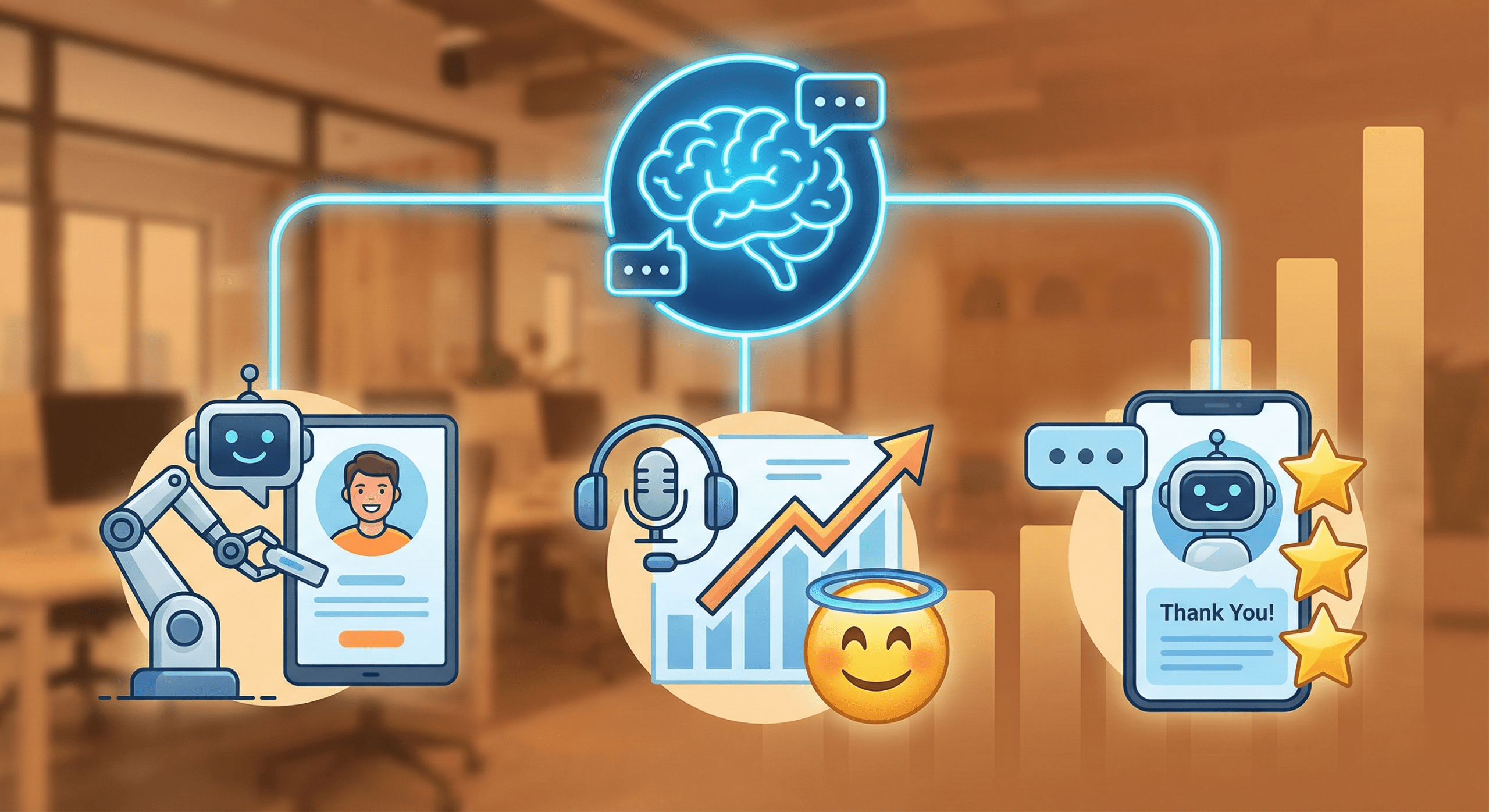
Customer satisfaction is no longer driven by friendly service alone. In a world shaped by instant messaging, on-demand services, and real-time updates, speed and availability have become the strongest predictors of how customers rate their experience. This is where Conversational AI—especially AI Voice Bots and AI Receptionists—has emerged as a game changer.
Businesses that once focused solely on agent training are now realizing that how fast and how consistently they respond matters just as much as what they say. Conversational AI directly addresses these expectations, leading to measurable improvements in Customer Satisfaction Scores (CSAT) across industries.
In fact, the same technologies that eliminate queues and idle time—explored in “The End of ‘Please Hold’: How AI Voice Bots Are Killing Long Wait Times”—are also the strongest drivers behind rising CSAT scores today.
Below are the three most impactful ways Conversational AI boosts customer satisfaction, with a clear focus on instant response and 24/7 availability.
Why CSAT Is Closely Tied to Speed and Availability
Before diving into the three ways, it’s important to understand a key shift in customer psychology:
Customers don’t compare your service to competitors anymore—they compare it to the best digital experience they’ve ever had.
That means:
- Waiting feels unacceptable
- “Business hours” feel outdated
- Repeating information feels careless
Conversational AI solves all three problems at once when deployed through a unified communication platform like Maxlink Solutions.
1. Instant Response: The Single Biggest CSAT Multiplier
Speed Is the New Courtesy
Historically, good service meant polite agents and helpful answers. Today, good service starts with answering immediately.
Conversational AI ensures:
- Calls are picked up instantly
- Chats receive immediate replies
- No customer is placed in a queue
An AI Receptionist built into a modern Cloud PBX system answers every inbound call the moment it comes in—regardless of volume.
This alone can dramatically increase CSAT.
How Instant Response Improves Satisfaction
When customers are answered immediately:
- Frustration never has time to build
- Trust increases from the first interaction
- The conversation starts on a positive emotional baseline
By contrast, even a 30–60 second wait can negatively impact satisfaction—before the issue is even discussed.
This is why the removal of hold times, discussed in “The End of ‘Please Hold’: How AI Voice Bots Are Killing Long Wait Times”, has such a direct effect on CSAT. When there is no waiting, there is no initial dissatisfaction to overcome.
Intent-Based Conversations Reduce Resolution Time
Conversational AI doesn’t just answer quickly—it understands why the customer is calling.
Using Natural Language Processing (NLP), AI Voice Bots:
- Identify intent from natural speech
- Skip unnecessary questions
- Route or resolve issues immediately
Integrated with intelligent IVR systems, AI eliminates the friction of “Press 1, Press 2” menus that frustrate customers and drag down satisfaction scores.
CSAT Impact
Direct results businesses see:
- Lower call abandonment rates
- Shorter average handle times
- Higher first-contact resolution
All three metrics strongly correlate with higher CSAT.
2. 24/7 Availability: Satisfaction Doesn’t Keep Office Hours
Customers Expect Help—Anytime
Modern customers don’t plan their issues around business hours. They expect support:
- Late at night
- On weekends
- During holidays
Conversational AI makes true 24/7 availability possible without staffing night shifts or paying overtime.
An AI Receptionist connected through Phone and omnichannel tools ensures that every customer is acknowledged—even outside standard hours.
Why 24/7 Availability Directly Raises CSAT
When customers hear silence or voicemail after hours, satisfaction drops immediately—even if the issue is resolved later.
Conversational AI avoids this by:
- Answering calls at any time
- Providing instant information (hours, order status, FAQs)
- Logging requests for follow-up
- Scheduling callbacks
This creates a feeling of being valued, not ignored.
Always-On Support Without Burnout
Human agents are limited by schedules. AI is not.
With AI handling first-line interactions:
- Agents return to manageable workloads
- Responses remain fast even during spikes
- Quality doesn’t degrade overnight
Supervisors can monitor performance through Contact Center tools and the Supervisor Dashboard, ensuring service quality stays consistent around the clock.
CSAT Impact
Customers consistently rate experiences higher when:
- Their call is answered, even after hours
- They receive immediate acknowledgment
- They are given clear next steps
24/7 availability turns a potential frustration into a positive surprise—one of the strongest drivers of satisfaction.
3. Consistency Across Channels: No Repeating, No Confusion
Consistency Builds Confidence
One hidden CSAT killer is inconsistency:
- Different answers from different agents
- Having to repeat the same issue
- Losing context when switching channels
Conversational AI eliminates this by acting as a central intelligence layer across voice, chat, and messaging.
Unified Conversations Across Channels
When deployed as part of an integrated ecosystem—covering Chat, SMS, and voice—AI ensures:
- Conversations continue seamlessly
- Customer context is preserved
- Responses remain consistent and accurate
For example:
A customer may call after hours, receive help from an AI Voice Bot, and later continue the conversation via SMS without starting over.
This continuity is powered by integrations such as CTI and unified routing within the communication platform.
AI + Human Handoff Without Friction
When a conversation requires a human agent:
- AI transfers the interaction with full context
- Agents see intent, history, and sentiment
- Customers don’t need to repeat themselves
This smooth transition dramatically improves perceived service quality.
It also reinforces the benefits described in “The End of ‘Please Hold’: How AI Voice Bots Are Killing Long Wait Times”, where speed and continuity work together to eliminate frustration at every step.
CSAT Impact
Customers report higher satisfaction when:
- They don’t repeat information
- They receive consistent answers
- They feel “remembered” by the system
Consistency transforms service from reactive to professional.
Why Conversational AI Improves CSAT More Than Training Alone
Many organizations attempt to improve CSAT by:
- Coaching agents
- Updating scripts
- Increasing staffing
While valuable, these approaches don’t address the structural causes of dissatisfaction:
- Waiting
- Limited availability
- Repetition
Conversational AI fixes the structure itself.
By embedding AI into a scalable platform like Maxlink Solutions, businesses redesign the customer journey rather than patching problems.
Measuring the CSAT Lift from Conversational AI
Businesses that adopt Conversational AI typically see improvements in:
- CSAT scores
- Net Promoter Score (NPS)
- First Response Time
- First Contact Resolution
These gains are especially visible when AI is deployed at the front desk level using Cloud PBX and contact center integrations.
Transparent deployment and support—available through the Support Portal—ensure systems stay optimized as customer needs evolve.
The Bigger Picture: CSAT as a Competitive Advantage
High CSAT is no longer just a metric—it’s a differentiator.
Customers who experience:
- Instant answers
- 24/7 support
- Seamless conversations
are more likely to:
- Stay loyal
- Spend more
- Recommend the brand
This is why businesses evaluating AI solutions often start by understanding the broader value proposition on Why Maxlink Solutions.
Final Thoughts
Conversational AI doesn’t boost CSAT by being “smarter” than humans—it boosts CSAT by being faster, always available, and consistent.
By eliminating wait times, extending support beyond office hours, and maintaining continuity across channels, AI creates the kind of experience customers now expect by default.
As shown in “The End of ‘Please Hold’: How AI Voice Bots Are Killing Long Wait Times”, the removal of friction is the real revolution. Higher CSAT isn’t a side effect—it’s the natural outcome.
For businesses serious about customer satisfaction, Conversational AI is no longer optional. It’s foundational