Elastic Trunking: Effortlessly Scaling SIP Capacity During Traffic Surges
Every business phone system has a ceiling: the maximum number of calls it can carry at the same moment. For most of the year, that ceiling is invisible. Call volume rises and falls within a comfortable range, and nobody thinks about how many call paths the system was provisioned for. Then a product launch goes viral, a storm knocks out service across a region, a billing error hits thousands of customers at once, or the holiday rush arrives early, and suddenly the ceiling is the only thing that matters. Callers hear busy signals, outbound campaigns stall, and agents sit idle while customers can’t get through.
Elastic SIP trunking exists to remove that ceiling, or at least to move it so far up that traffic surges stop being a capacity problem. Instead of locking a business into a fixed number of concurrent call paths, elastic trunking lets capacity expand automatically when demand spikes and contract when it falls back. Understanding how it works, and what it takes to use it well, is the difference between a phone system that absorbs a surge and one that fails publicly at the worst possible moment.
The Problem With Fixed Channel Capacity
Traditional telephony was built around fixed capacity. A PRI line carried 23 voice channels, no more and no less, and adding capacity meant ordering another circuit and waiting weeks for installation. Early SIP trunking often carried the same assumption forward in a new form: businesses bought a set number of concurrent call paths, sized to their expected peak, and paid for that capacity every month whether it was used or not.
That model forces a bad trade-off. Size capacity for the average day and you’ll drop calls during every spike. Size it for the worst day of the year and you’ll pay for idle channels the other 364 days. Most businesses split the difference and hope, which means they’re overpaying most of the time and still under-provisioned when it really counts. When the limit is reached, new inbound calls are rejected, usually with a busy signal or a network error message, and outbound calls simply fail to connect. The customer doesn’t know or care that the business hit a channel limit; they only know they couldn’t get through.
How Elastic SIP Trunking Works
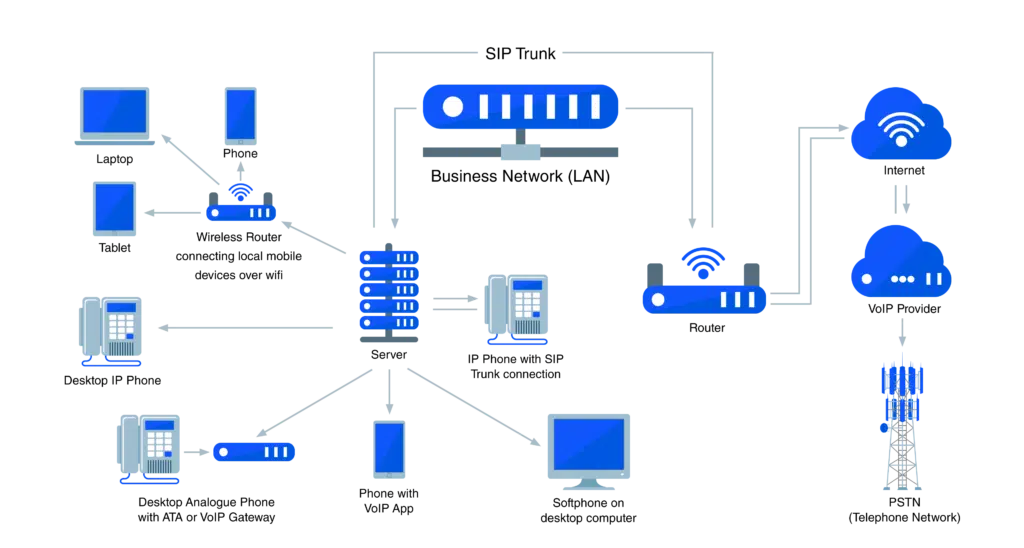
Elastic trunking separates the capacity you normally use from the capacity you’re allowed to reach. A business typically keeps a baseline number of call paths that covers everyday traffic, and the trunk is configured to burst above that baseline automatically when more concurrent calls arrive. Because SIP runs over IP rather than physical circuits, there’s no hardware to install and no new line to order. The provider’s network simply accepts additional sessions up to a much higher limit, and those extra paths are released once the surge passes.
Billing usually follows one of two patterns. Some providers charge a base rate for committed capacity plus a usage-based rate for burst calls. Others price entirely on usage, billing per minute or per concurrent peak rather than per channel. Either way, the key shift is that capacity becomes something the system adjusts in real time rather than something an administrator has to predict months in advance. For businesses with seasonal or event-driven traffic, that alone can cut telecom spend significantly while raising the ceiling on what the system can handle.
Where Traffic Surges Actually Come From
Surges are rarely random. Retailers see predictable spikes around Black Friday, holiday shipping deadlines, and returns season. Healthcare practices see appointment calls jump during flu season and open enrollment. Utilities, insurers, and property managers get flooded during storms and outages, exactly when their customers are most stressed. Marketing teams create their own surges with TV spots, email campaigns, and promotions that drive thousands of people to call the same number within minutes. Outbound teams create surges too, when a call campaign or appointment-reminder run kicks off across a large contact list.
The common thread is that the highest-stakes calls tend to arrive during the highest-volume moments. A business that can’t scale its voice capacity during those windows isn’t just losing calls, it’s losing them at the moments customers will remember. Elastic trunking aligns capacity with those real-world patterns instead of a static estimate.
The Network Has to Scale Too
Elastic call paths only help if the network underneath them can carry the extra traffic. Each concurrent call using the G.711 codec needs roughly 87 kbps of bandwidth in each direction once packet overhead is included, while compressed codecs like G.729 need far less. A business that bursts from 50 to 200 concurrent calls needs enough upstream and downstream bandwidth to carry all 200 without dropped packets, jitter, or choppy audio.
That means planning internet capacity for peak voice load, not average load, and configuring quality-of-service rules so voice traffic is prioritized over file uploads, video streams, and backups. For cloud-hosted contact centers, much of this load sits in the provider’s infrastructure rather than the customer’s office, which is one reason businesses with large surge exposure often pair elastic trunking with a cloud contact center platform instead of routing everything through on-site equipment.
Capacity Without Redundancy Is Still a Single Point of Failure
Scaling up during a surge is only half the job; staying up is the other half. Surges often coincide with conditions that stress infrastructure, such as regional outages, severe weather, or unusually heavy internet traffic. An elastic trunk that terminates in a single data center, or relies on a single internet connection at the customer site, can still fail under exactly the conditions it was meant to handle.
Well-designed elastic trunking routes calls across geographically redundant points of presence, fails over automatically when one path degrades, and can reroute inbound numbers to mobile devices or alternate sites if a location goes dark. This is the same carrier-grade redundancy principle that applies to every critical communications system: capacity and resilience have to be designed together.
Keeping Costs Predictable While Capacity Flexes
The most common hesitation about usage-based capacity is cost control. If capacity can expand without limit, what stops a runaway campaign, a misconfigured dialer, or toll fraud from producing a shocking bill? The answer is guardrails. Good elastic trunking platforms let administrators set burst caps per trunk or per location, define alert thresholds when concurrent calls cross a set level, and restrict international or premium-rate destinations unless they’re explicitly allowed.
Real-time dashboards showing concurrent calls, burst usage, and spend help finance and IT teams see what a surge actually cost and whether the baseline should be adjusted. Over a few months, that data usually reveals a much lower true baseline than the business was paying for under a fixed-channel model, along with a clear picture of how often and how high real surges go.
Building a Phone System That Expects the Surge
Traffic surges are not edge cases. For most businesses, they’re the moments that matter most: the busiest sales days, the most urgent support needs, the times when customers decide whether a company is reliable. Elastic SIP trunking turns those moments from a capacity gamble into something the system handles on its own, without new hardware, emergency circuit orders, or paying for idle channels all year.
MaxLink’s SIP trunking is built to scale with real demand, backed by redundant infrastructure and the monitoring tools needed to keep costs under control. If your phone system has ever buckled during a busy period, or you’re paying for capacity you only use a few days a year, it’s worth looking at how elastic trunking could reshape both your reliability and your telecom budget.