Next-Gen Virtual Agents: How Generative AI is Reshaping Inbound Support
From Scripted Bots to Intelligent Virtual Agents
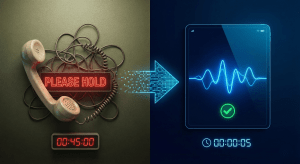
Traditional automated support systems are generally built around predefined rules. They work well when customers follow expected paths, but conversations rarely stay perfectly predictable. A customer may call with a question that does not match the wording anticipated by the system, combine several requests into one conversation, or change their mind halfway through an interaction. Generative AI approaches this differently by interpreting the meaning and context behind what the customer says rather than relying entirely on exact phrases or fixed menu selections. This allows virtual agents to have more natural conversations and respond to a broader range of customer requests. Instead of simply identifying “billing” as an intent and transferring the caller, an AI agent can potentially understand that the customer is questioning a recent charge, retrieve the relevant account information, explain the charge, and take an appropriate next action when the connected systems and permissions allow it.
The biggest change is that these systems are becoming capable of moving from answering questions to completing tasks. Generative AI agents can be connected with business systems, knowledge bases, APIs, CRM platforms, and other tools so that the conversation can result in an action rather than stopping at information. For example, a customer might ask about an order, request a return, change account information, check an appointment, or ask about a service issue. Instead of simply explaining where the customer can complete that task, a properly configured AI agent can retrieve information and initiate or complete supported workflows. AWS describes this newer approach as agentic self-service, where AI agents can reason across multiple steps, use tools, maintain conversational context, and escalate to a human when necessary.
Why Generative AI Matters for Inbound Support
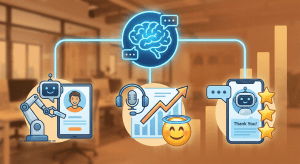
Inbound support teams deal with a constant mixture of simple, repetitive requests and complex conversations that genuinely require human expertise. This creates an efficiency problem when highly trained employees spend large portions of their day answering questions that could potentially be handled automatically. Generative AI can take responsibility for a larger portion of routine interactions while allowing human representatives to concentrate on cases where judgment, empathy, negotiation, or specialized knowledge is required. This does not necessarily mean removing people from the support process. Instead, it can create a layered model in which the virtual agent handles the initial interaction, gathers relevant information, attempts resolution, and brings in a human when the situation requires additional expertise.
This approach can also make the transition between AI and human support much smoother. A poorly designed automated system may force customers to repeat everything they have already explained after being transferred to an employee. Modern AI-powered contact-center systems are designed to preserve conversational context and customer information so that the human representative can understand what has already happened. That can include the customer’s original request, information gathered during the interaction, actions already attempted, and relevant account or case information. The result is a support experience in which escalation does not have to feel like starting over. AWS documentation describes AI agents that can autonomously handle issues while escalating to human agents when necessary, with customer context carried into the next stage of the interaction.
Virtual Agents Can Support More Than Phone Calls
Another major shift is that generative AI is no longer limited to a single support channel. Customers may begin with a phone call, continue through chat, respond to an SMS, or follow up through email. Modern contact-center platforms are increasingly designed around omnichannel experiences in which customer information and interaction history can move between channels. This is important because customers do not necessarily think in terms of communication channels; they think in terms of getting a problem solved. If someone has already explained an issue through chat, they should not have to provide the same background again simply because they decide to call.
For businesses, this creates an opportunity to provide a more consistent support experience across the customer journey. A virtual agent can help answer questions on a website, assist through messaging, handle supported voice interactions, and pass relevant context to a human representative when escalation is required. AWS currently describes generative AI capabilities across voice, chat, email, SMS, and other channels, with customer context and interaction history helping connect those experiences.
AI and Human Agents Work Better Together
The future of inbound support is not necessarily AI versus human agents. In many contact centers, the more practical model is AI working alongside people. Generative AI can support employees during live conversations by identifying customer intent, finding relevant information, recommending responses, and suggesting possible next actions. This gives representatives an intelligent layer of assistance without requiring them to search through multiple knowledge bases or applications while a customer is waiting.
What This Means for Modern Contact Centers
Generative AI is changing the role of the inbound contact center from a place where every customer request must be manually processed into a more intelligent environment where technology and people share responsibility. Virtual agents can absorb routine demand, provide immediate assistance, gather information, complete supported tasks, and route complicated cases to the right employees. Human representatives can then spend more of their time on interactions that require expertise and personal attention rather than repeatedly handling predictable requests.
For businesses, the opportunity is not simply to add an AI chatbot or replace an old phone menu. The bigger opportunity is to rethink how inbound support works from beginning to end. That may involve connecting an AI virtual assistant with existing customer-service workflows, strengthening the organization’s contact center infrastructure, or using an AI receptionist to manage incoming calls and routine customer interactions. The goal is to create a system where customers can communicate naturally, receive useful answers quickly, and reach a human without unnecessary friction when human assistance is needed.
Generative AI is pushing inbound support toward a more conversational and action-oriented model. The next generation of virtual agents will increasingly be expected to understand context, work across channels, interact with business systems, and coordinate multiple steps instead of simply responding to individual questions. Emerging agent-to-agent capabilities are also allowing specialized AI agents to collaborate during customer interactions, with one agent handling the conversation while another performs a specialized task behind the scenes.