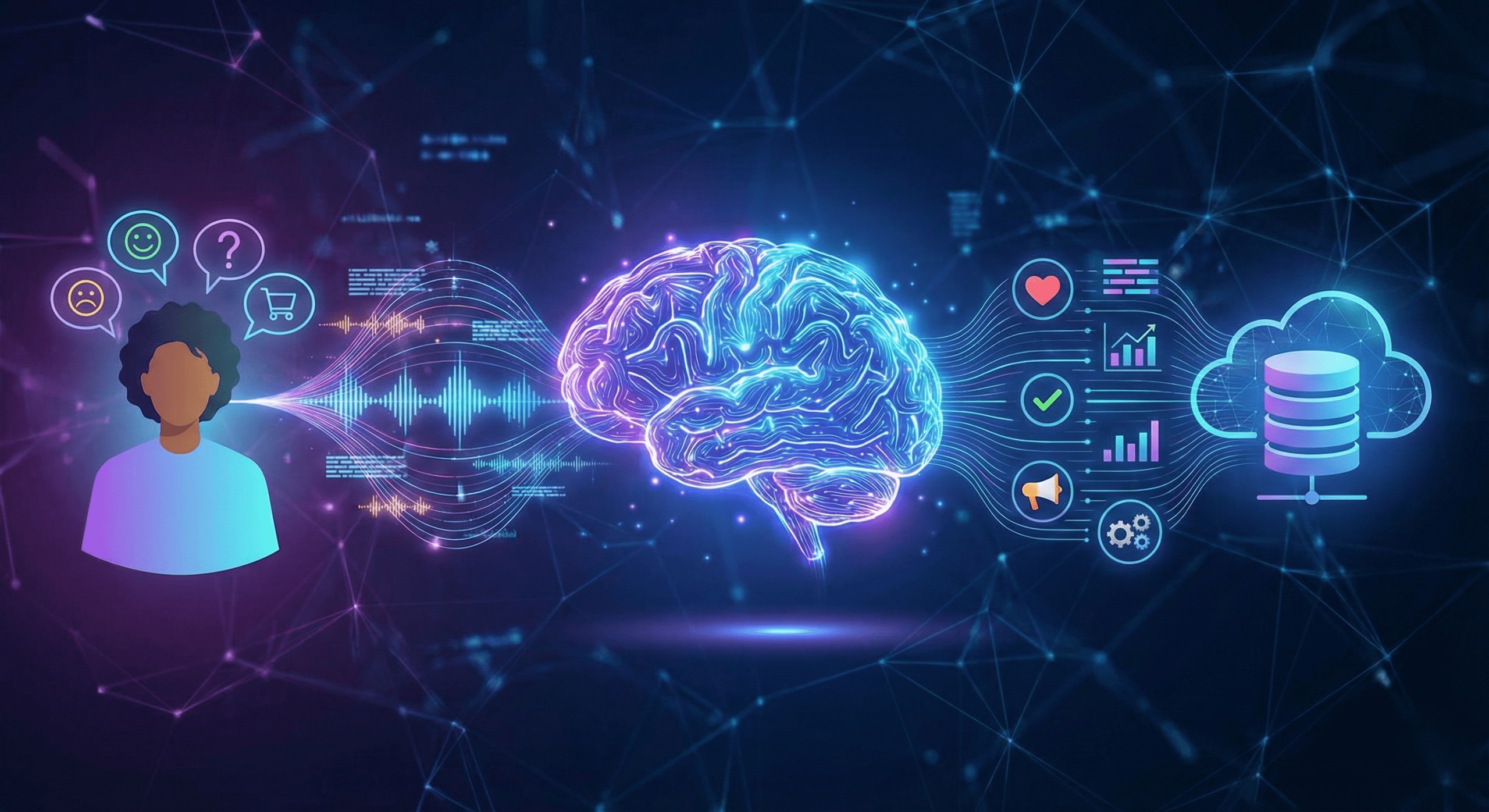
When customers speak to a business, they don’t think in keywords, menus, or scripts—they speak naturally. They explain problems in their own words, express urgency through tone, and expect to be understood the first time. This is where Natural Language Processing (NLP) becomes the intelligence behind modern AI-driven conversations.
NLP is the technology that allows AI voice bots and virtual assistants to listen, interpret, and respond like a human, turning raw speech into meaningful action. It is the foundation that enables systems such as Maxine AI to operate as true conversational experts rather than simple automated responders—an approach central to the always-on experience described in Meet Maxine: The AI Assistant That Never Sleeps.
What Is Natural Language Processing?
Natural Language Processing is a branch of artificial intelligence that focuses on enabling machines to understand human language as it is spoken or written.
Unlike traditional systems that rely on fixed commands, NLP allows AI to work with:
- Everyday speech
- Informal phrasing
- Accents and variations
- Contextual meaning
This makes it possible for AI to participate in real conversations rather than forcing customers to adapt to technology.
Why Keyword-Based Systems Fail Customers
Older automated systems rely on keyword detection:
- “Billing”
- “Support”
- “Sales”
If a caller doesn’t say the expected word, the system fails—often sending them to the wrong department or restarting the menu.
NLP replaces this brittle logic with intent recognition.
Instead of listening for specific words, NLP analyzes:
- Sentence structure
- Word relationships
- Context within the conversation
So phrases like:
- “I was charged twice”
- “My invoice looks wrong”
- “There’s an issue with my payment”
are all understood as the same billing-related intent, even though none of them use identical wording.
How NLP Works Inside Conversational AI
1. Speech-to-Text Conversion
The first step in NLP-driven conversations is converting spoken language into text. Advanced speech recognition models account for:
- Different accents
- Speaking speeds
- Background noise
This ensures accurate interpretation even in real-world conditions.
2. Intent Detection
Once speech is converted into text, NLP models analyze the meaning behind it.
The system determines:
- What the customer wants
- How urgent the request is
- Whether it requires a human agent
This is how AI decides whether to resolve an issue instantly or route the call intelligently.
3. Entity Recognition
Beyond intent, NLP identifies entities—specific pieces of information such as:
- Names
- Account numbers
- Dates
- Locations
This allows AI to gather useful details naturally during the conversation without sounding interrogative.
4. Context Retention
One of the most powerful aspects of NLP is context awareness.
NLP allows AI to remember:
- What was said earlier in the conversation
- Clarifications provided by the caller
- Follow-up questions
This prevents repetitive questioning and keeps conversations flowing smoothly.
NLP and Emotional Understanding
While AI does not “feel” emotions, NLP can recognize emotional cues in language.
Indicators such as:
- Word choice
- Sentence length
- Repetition
- Urgency markers
help the system determine whether a caller is frustrated, confused, or calm. This enables AI to adjust tone, escalate appropriately, or move faster toward resolution.
Why NLP Improves the Customer Experience
Customers judge service quality by how well they are understood.
NLP-driven systems:
- Reduce misunderstandings
- Shorten conversations
- Increase first-contact resolution
- Eliminate unnecessary transfers
By understanding intent instead of forcing structure, NLP removes friction from customer interactions.
NLP in Real-World Business Conversations
In modern business environments, NLP enables AI to:
- Route calls accurately in inbound call centers
- Handle after-hours conversations without scripts
- Support global customers with diverse speech patterns
- Maintain consistency across voice and messaging channels
These capabilities allow AI to act as a reliable front desk, not just a call router.
NLP and Human-Agent Collaboration
NLP doesn’t replace human agents—it supports them.
When escalation is required, NLP passes:
- Caller intent
- Key details
- Conversation context
to human agents, allowing them to step in informed and prepared. This seamless handoff is critical to maintaining trust and satisfaction.
The Technology Behind the Conversation
Behind the scenes, NLP models are trained on vast datasets of real conversations. Over time, they learn:
- Common customer intents
- Language patterns
- Industry-specific terminology
This continuous learning allows AI systems to improve accuracy and relevance with every interaction.
Final Thoughts
Natural Language Processing is what transforms AI from a tool into a conversational partner. By understanding intent, context, and nuance, NLP allows businesses to meet customers where they are—speaking naturally, without friction or frustration.
It is the intelligence that makes modern AI assistants feel responsive, capable, and human—and the reason conversational systems like Maxine AI can deliver always-on, high-quality interactions at scale.